From recognising images to processing language, neural networks power many of the AI systems we interact with every day. But how do these networks turn data into useful predictions? Understanding their structure, mathematical operations, and training process helps explain how machines learn increasingly complex patterns.
At the core of this process are artificial neurons, interconnected layers, and adjustable parameters that work together to process information. During training, a neural network uses examples to learn patterns, measures how well its predictions match the expected outputs, and adjusts its parameters to improve its performance. Understanding how these components interact provides a foundation for exploring how neural networks work, why they are effective at solving complex problems, and what limitations we need to consider when using them.
1. What exactly is a neural network?
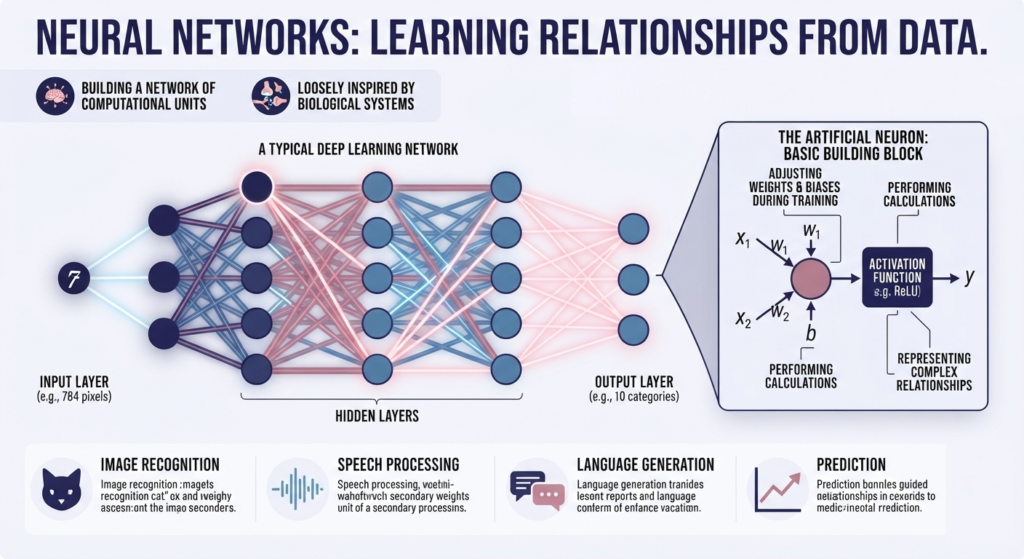
Neural networks are a type of machine learning model designed to learn relationships between inputs and outputs. They are widely used in tasks such as image recognition, speech processing, language generation, and prediction.
The idea behind them is relatively straightforward: instead of manually programming every rule a system needs to follow, we build a network of computational units that can learn useful patterns from data.
Artificial neural networks are loosely inspired by biological nervous systems, particularly the interconnected neurons found in the brain. However, artificial neurons are mathematical functions, and their operation is very different from that of biological neurons.
An artificial neural network consists of interconnected units organised into layers. These units perform calculations on incoming information, transform it, and pass the results to other units. During training, the network adjusts numerical parameters called weights and biases to improve its performance on a particular task.
What makes neural networks particularly useful is their ability to represent complex relationships. A simple model might learn a straightforward relationship between two variables, while a sufficiently capable neural network can learn much more complicated patterns involving thousands or millions of input values.
To understand how this works, we need to start with the smallest building block of the network: an artificial neuron.
2. Inside an artificial neuron
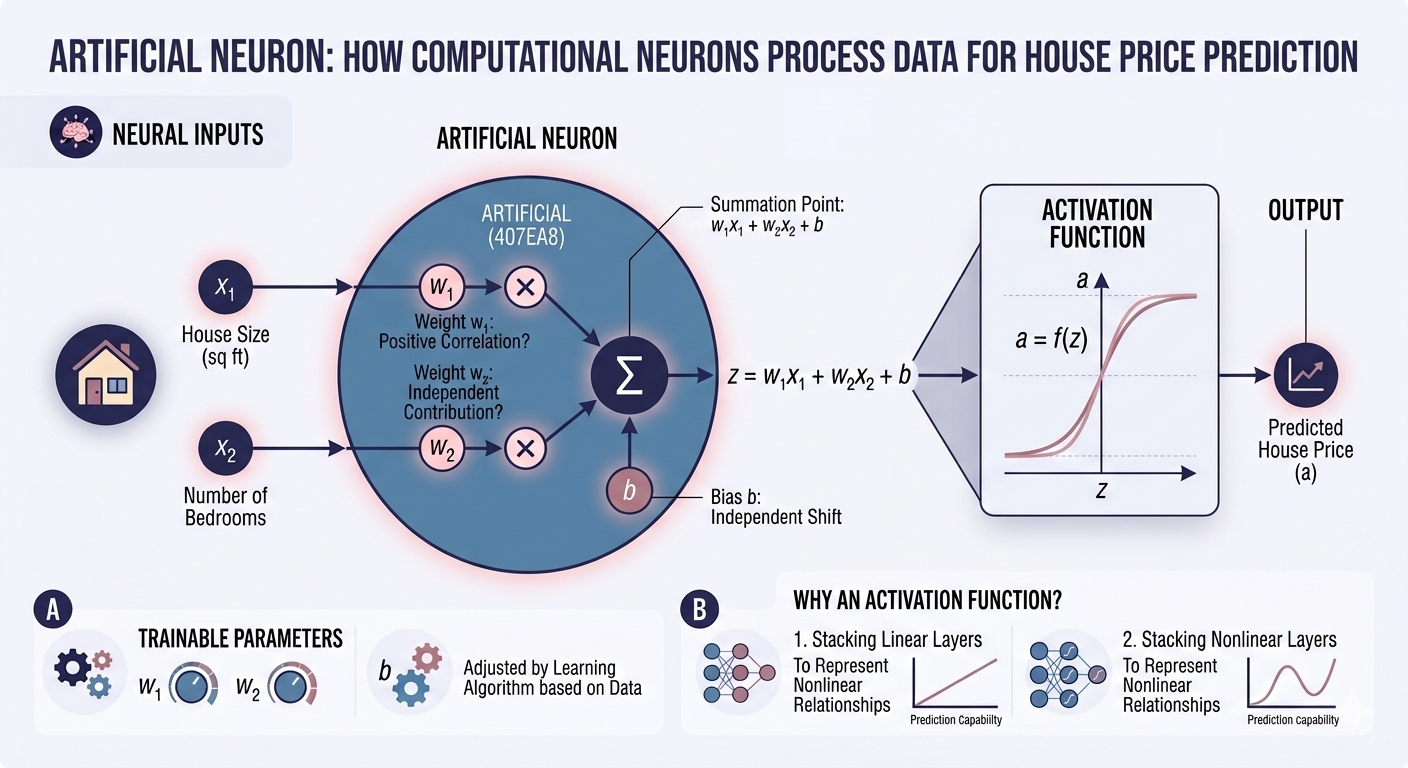
An artificial neuron receives numerical inputs, combines them using weights and a bias, and passes the result through an activation function.
Let’s break that down.
Suppose a model is trying to predict a house’s price using two features: its size and the number of bedrooms. These features become numerical inputs to the model.
Each input is associated with a weight, which influences how strongly that input contributes to the calculation. The neuron combines the weighted inputs and adds a bias.
Mathematically, this can be represented as:
z = w₁x₁ + w₂x₂ + b
Here, x₁ and x₂ represent the inputs, w₁ and w₂ are their corresponding weights, and b is the bias.
The resulting value, z, is then passed through an activation function:
a = f(z)
The activation function transforms the result into the neuron’s output.
Weights and biases are trainable parameters. During training, a learning algorithm adjusts them so that the network’s predictions become more useful for the task.
For example, a weight associated with house size might become positive if larger houses generally correspond to higher prices in the training data. However, the exact value depends on the data, the model’s structure, and the training process.
The bias allows the neuron to shift its calculation independently of the input values.
But why do we need an activation function? Why not simply calculate the weighted sum and pass it along?
Activation functions help neural networks represent nonlinear relationships. Without nonlinear activation functions, stacking multiple layers of ordinary linear transformations would still produce an overall linear transformation. That would limit the complexity of the relationships the network could learn.
This brings us to the structure that makes neural networks more powerful than a single artificial neuron.
3. How layers work together
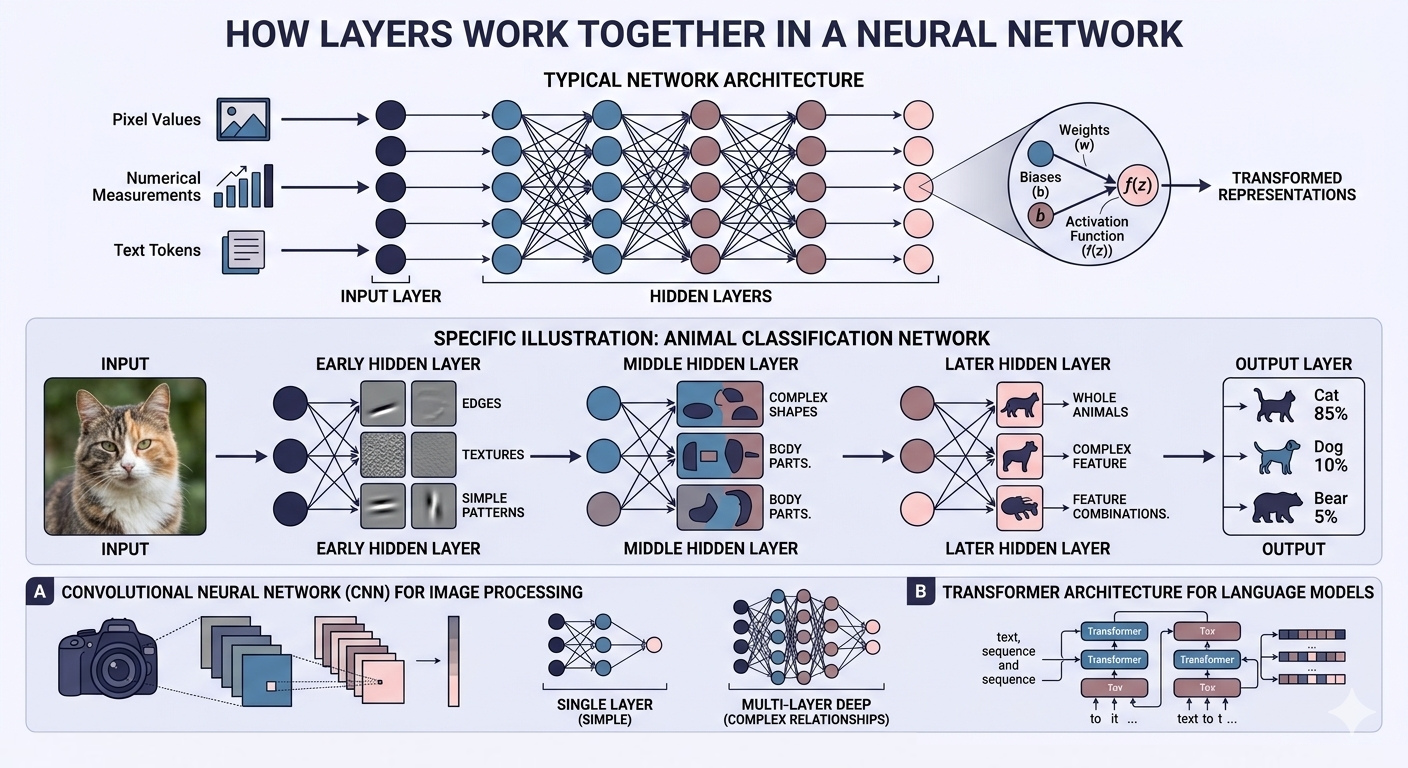
A neural network typically contains an input layer, one or more hidden layers, and an output layer.
The input layer receives the features provided to the model. These might be pixel values from an image, numerical measurements from a dataset, or representations of words and other tokens.
The hidden layers perform calculations that transform these inputs into representations useful for the task. Each layer receives information from the preceding layer, applies learned weights and biases, and usually uses an activation function before passing information forward.
Finally, the output layer produces the result. Depending on the task, this might be a predicted numerical value, probabilities for different classes, or another type of output.
Consider a network trained to classify photographs of animals.
The input might consist of the image’s pixel values. Early layers could learn representations responsive to visual features such as edges and textures. Later layers might combine information into more complex patterns that help distinguish animals.
This is a simplified illustration rather than a universal description of how every network learns. The representations depend on the architecture, training data, and objective.
The important principle is that each layer transforms information, allowing the network to build more complex representations from its inputs.
Adding hidden layers can increase the kinds of relationships a network is capable of representing, although deeper networks can also be harder to train and do not automatically perform better.
The number of layers, their connections, and the operations they perform are part of the network’s architecture.
Different architectures are designed for different types of problems. Convolutional neural networks, for example, have been widely used in image processing, while transformer architectures are central to many modern language models.
Before exploring those differences, however, it helps to understand how information actually moves through a network.
4. Forward propagation: from input to prediction
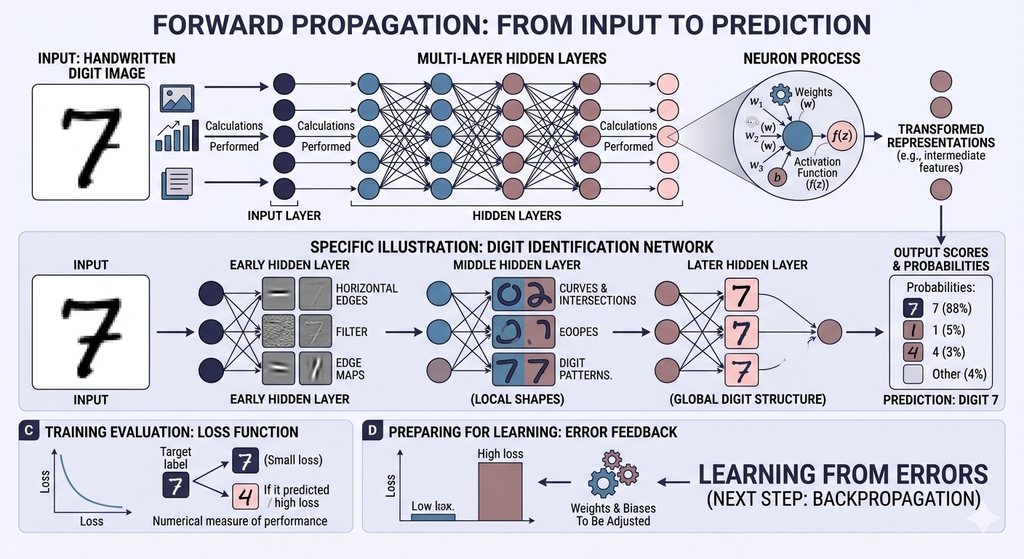
When a neural network receives an input and calculates its output, the process is called forward propagation, or a forward pass.
The input enters the first layer, calculations are performed, and the resulting values are passed through successive layers until the network produces its prediction.
Consider a network trained to identify handwritten digits. It receives an image and produces scores corresponding to possible classes, such as the digits zero through nine.
Those scores can be converted into probabilities using a suitable output function, such as softmax, depending on the model’s design.
The network might assign the highest probability to the digit seven. That is its prediction, but we cannot assume it is correct simply because the model produced it.
During training, the prediction is compared with the expected label using a loss function. This provides a numerical measure of how well the model performed on that example.
If the network predicts the wrong digit, its parameters may need to be adjusted. If its predictions are consistently accurate on appropriate evaluation data, that provides evidence that it has learned useful patterns.
Forward propagation therefore explains how a neural network produces an output. But it doesn’t explain how the network improves.
For that, we need to examine how the model learns from its errors.
5. Backpropagation: tracing how errors affect the network
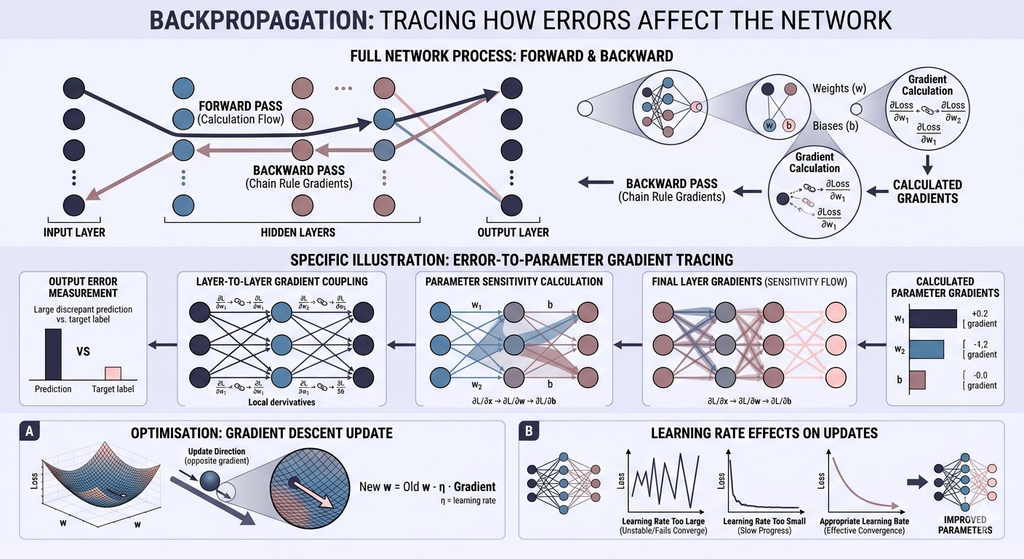
A neural network can contain many layers and a large number of trainable parameters. Adjusting every parameter individually would be impractical.
This is where backpropagation becomes essential.
Backpropagation is an algorithmic method for calculating how the loss function changes with respect to the network’s parameters. It uses the chain rule from calculus to calculate gradients efficiently, working backwards through the network’s computational operations.
To see why this matters, imagine that a neural network makes a prediction that differs from the expected answer.
The loss function measures the discrepancy. Backpropagation then calculates how changes to individual weights and biases would affect that loss.
These calculations produce gradients, which indicate how sensitive the loss is to changes in the parameters.
An optimisation algorithm can use those gradients to update the parameters in an attempt to reduce the loss.
One commonly used optimiser is gradient descent, which adjusts parameters in the direction opposite to the loss gradient.
A simplified update rule is:
New weight = Old weight − Learning rate × Gradient
The learning rate determines the size of the update.
If the learning rate is too large, training may become unstable or fail to converge effectively. If it is too small, training may progress very slowly.
Backpropagation and gradient descent are related, but they are not the same thing. Backpropagation calculates gradients; gradient descent uses gradients to update parameters. Modern neural networks may use other optimisers, such as Adam, which adapt parameter updates using additional information about past gradients.
Together, these methods allow a network to improve its parameters over repeated training steps.
However, a single update doesn’t guarantee that a prediction will become correct. Training involves many updates, and its success depends on factors such as the architecture, data, loss function, and optimisation settings.
6. Training a neural network
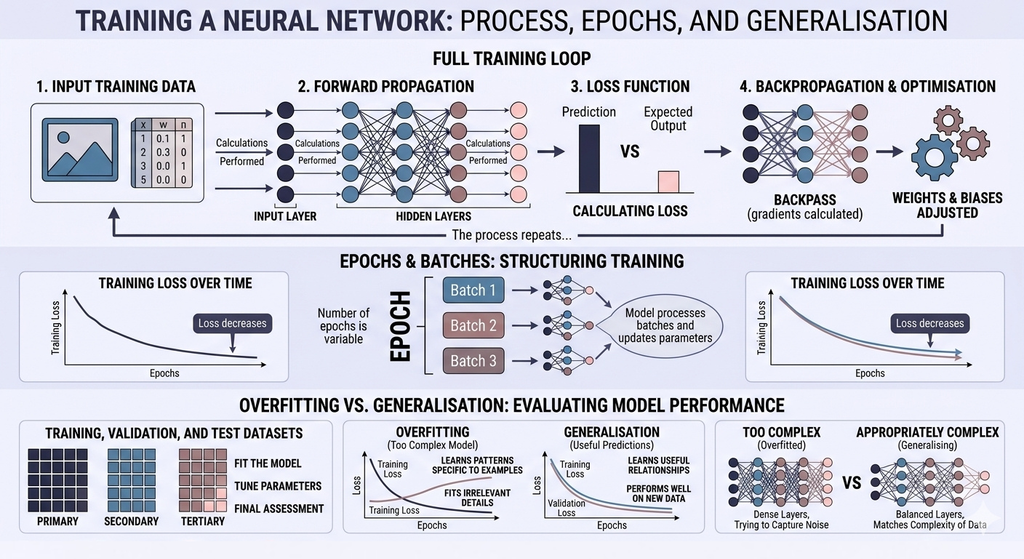
Training brings all these components together.
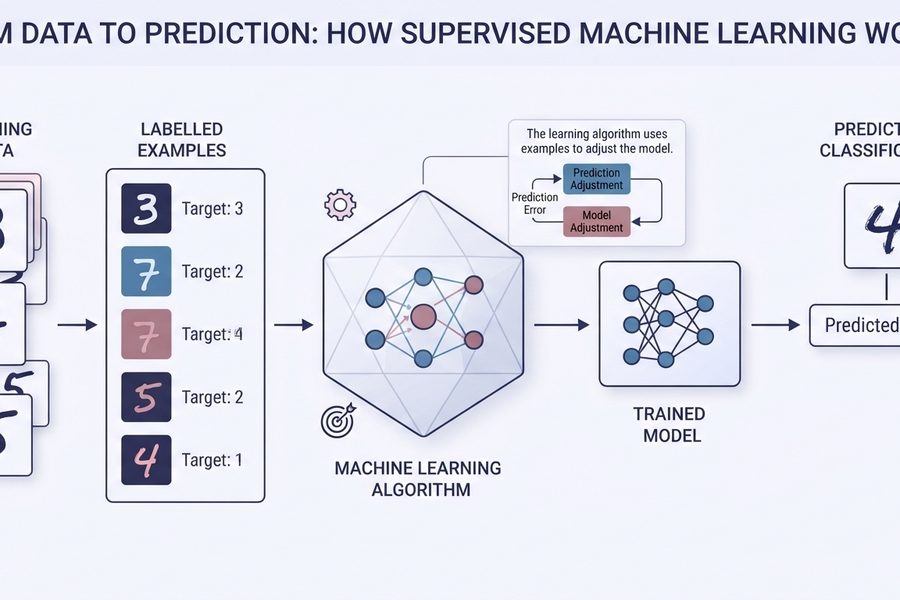
First, the model is given training data. Its parameters are initialised, and the network processes the inputs through forward propagation to produce predictions.
Next, a loss function measures the difference between the predictions and the expected outputs. Backpropagation calculates the gradients, and an optimiser uses them to update the trainable parameters.
The process repeats across the training dataset.
An epoch is one complete pass through the training dataset. Because datasets can be large, training is commonly divided into smaller groups of examples called batches. The model processes these batches and updates its parameters according to the training procedure.
Over multiple training steps and epochs, the network can learn parameter values that reduce the training loss.
But a lower training loss doesn’t necessarily mean a better model.
A network can overfit its training data, learning patterns specific to those examples rather than relationships that generalise to unfamiliar inputs. This can happen when a model is too complex for the available data or when its training process allows it to fit irrelevant details.
To evaluate performance, developers typically use separate training, validation, and test datasets. Training data helps fit the model, validation data supports model selection and tuning, and test data provides a final assessment on examples kept separate from those decisions.
The goal is not simply to make the network perform well on familiar examples. It is to develop a model that can make useful predictions on new data.
This ability is known as generalisation, and it is central to building reliable neural networks.
7. Why neural networks matter in modern AI
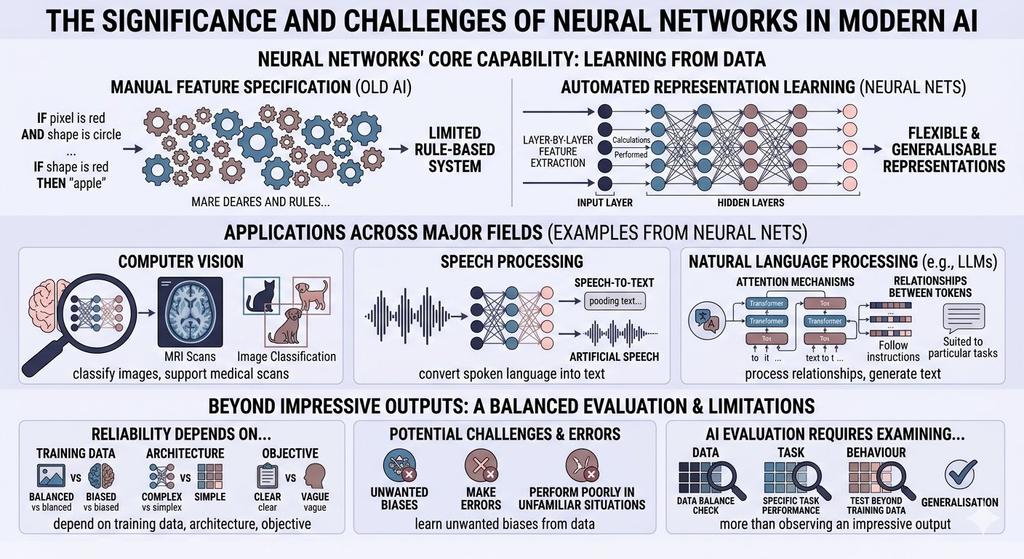
Neural networks are important because they can learn complex representations from data, reducing the need to manually specify every feature or relationship a system should recognise.
Their applications extend across many fields.
In computer vision, neural networks can classify images, identify objects, and support systems that analyse medical scans. In speech processing, they can help convert spoken language into text or generate artificial speech.
They also play a major role in natural language processing.
Modern large language models commonly use the transformer architecture, which relies on mechanisms such as attention to process relationships between tokens. These models are neural networks trained on large datasets, with parameters adjusted through optimisation.
During training, a language model can learn statistical patterns that help it predict tokens and generate text. Additional training may help it follow instructions or produce responses suited to particular tasks.
However, neural networks are not automatically reliable simply because they are complex. Their predictions depend on their training data, architecture, and objective. They can make errors, learn unwanted biases from data, and perform poorly when faced with unfamiliar situations.
Understanding their structure helps explain both their capabilities and their limitations.
It also highlights why evaluating AI requires more than observing an impressive output. We need to examine the data used, the task being performed, and how the model behaves beyond its training examples.
From understanding networks to building them
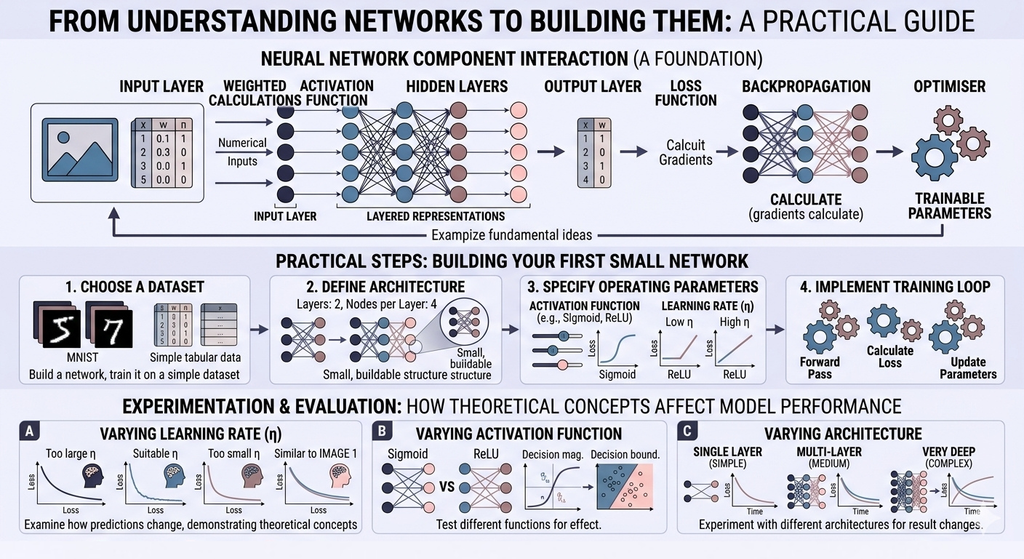
Neural networks bring together several fundamental ideas in machine learning: numerical inputs, weighted calculations, activation functions, layered representations, loss functions, and optimisation. Each component has a specific role, and their interaction allows a network to learn patterns that can be difficult to capture using simpler models.
The mathematics behind these systems can become complex, especially as networks grow deeper and their architectures become more sophisticated. However, understanding the basic mechanisms provides a foundation for exploring more advanced models.
A useful next step is to build a small neural network, train it on a simple dataset, and examine how its predictions change as its parameters are updated. Experimenting with different activation functions, learning rates, and network architectures can help demonstrate how theoretical concepts affect actual model performance.
Neural networks become much easier to understand when their mathematical operations are connected to something we can build, test, and evaluate.
References & Further Reading
- Google’s Machine Learning Crash Course — introductions to model training, loss, and optimisation.
- 3Blue1Brown: Neural Networks — visual explanations of neural network structure and learning.
- Deep Learning textbook — a more advanced reference covering the mathematics and theory behind deep learning.

0 comments